
How to find Orion and its belt, with times for 13 cities
How to find Orion: its belt is three stars in a short, straight row, low in the east on November evenings. Times for 13 cities, and why Australia flips it.
To find Orion, look for its belt: three stars of about the same brightness in a short, straight row, with an orange star, Betelgeuse, on one side and a blue-white one, Rigel, on the other. On November and December evenings the belt comes up in the east. By January it's already well up in the east-south-east as the sky gets dark, and from February to April it swings across the south and down into the west. From the northern hemisphere Orion stands upright when he's due south; from Australia he's on his head.
How to find Orion's belt
The belt is three stars, Alnitak, Alnilam and Mintaka, evenly spaced in a line about as long as five full Moons side by side. That's also three widths of your little finger held at arm's length (a pinky covers about 1 degree).
Once you have the belt, the rest of Orion hangs off it. Four bright stars make a tall hourglass with the belt as its waist: Betelgeuse, the orange one, and Bellatrix are the shoulders, and blue-white Rigel and Saiph are the feet. Betelgeuse to Rigel is about three-quarters of the span from your thumb to your little finger with your hand stretched out at arm's length.
Which way up he sits depends on when you look. Seen from the northern hemisphere, Orion comes up in the east lying on his side, so the belt points almost straight up, with Betelgeuse to its left and Rigel to its right. A few hours later, in the south, he's standing, Betelgeuse at the upper left and Rigel at the lower right.
East works everywhere because the belt sits almost exactly on the celestial equator, the sky's own equator above Earth's. Anything on that line rises due east and sets due west wherever you live. That's why both hemispheres get Orion, and why from Reykjavík to Sydney he comes up within a few degrees of due east.
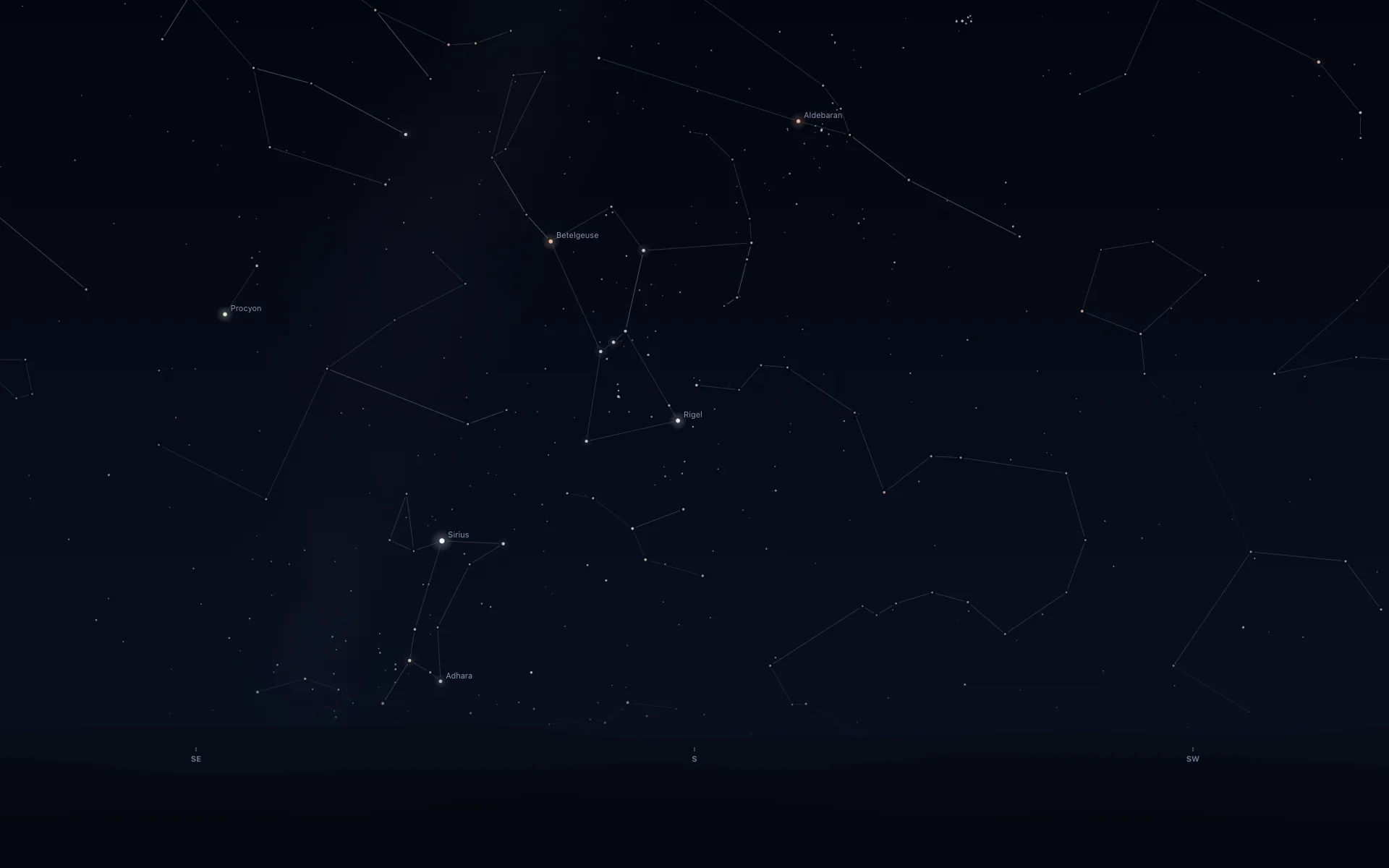
The stars in Orion and their names
| Star | Where, with Orion upright | Colour | Magnitude |
|---|---|---|---|
| Rigel | Lower right, a foot | Blue-white | 0.18 |
| Betelgeuse | Upper left, a shoulder | Orange-red | 0.45 |
| Bellatrix | Upper right, a shoulder | Blue-white | 1.64 |
| Alnilam | Middle of the belt | Blue-white | 1.69 |
| Alnitak | Left end of the belt | Blue-white | 1.74 |
| Saiph | Lower left, a foot | Blue-white | 2.07 |
| Mintaka | Right end of the belt | Blue-white | 2.25 |
They only look like a group from here. Betelgeuse is a red supergiant about 700 light-years away and Rigel a blue supergiant about 860 light-years away, so the light you see from Betelgeuse tonight set off around the 14th century.
Betelgeuse also changes. In late 2019 it dimmed so sharply that some scientists wondered if it was heading for a supernova. NASA's explanation is that the star threw off a burst of material that cooled into a cloud of dust and blocked some of its light, and by April 2020 it was back to its usual brightness.
When can you see Orion?
Every star rises about four minutes earlier each night, two hours a month, so Orion turns up earlier every evening from November on. "Ten degrees up" in the table means clear of most rooftops, though a hill or a tall building to the east will make you wait a little longer.
| City | 15 Nov | 15 Dec | 15 Jan | Highest on 15 Dec | How high |
|---|---|---|---|---|---|
| New York | 8:51 PM | 6:53 PM | 22° at dusk | 11:54 PM | 48° S |
| Chicago | 8:46 PM | 6:48 PM | 21° at dusk | 11:49 PM | 47° S |
| Denver | 8:53 PM | 6:55 PM | 23° at dusk | 11:58 PM | 49° S |
| Los Angeles | 8:42 PM | 6:44 PM | 27° at dusk | 11:51 PM | 55° S |
| San Diego | 8:36 PM | 6:38 PM | 28° at dusk | 11:46 PM | 56° S |
| San Francisco | 9:01 PM | 7:03 PM | 24° at dusk | 12:07 AM | 51° S |
| London | 9:10 PM | 7:12 PM | 15° at dusk | 11:59 PM | 37° S |
| Berlin | 9:18 PM | 7:20 PM | 14° at dusk | 12:06 AM | 36° S |
| Reykjavík | 11:10 PM | 9:12 PM | 7:11 PM | 1:27 AM | 25° S |
| Bengaluru | 9:01 PM | 7:03 PM | 39° at dusk | 12:19 AM | 76° S |
| Seoul | 9:26 PM | 7:28 PM | 24° at dusk | 12:32 AM | 51° S |
| Tokyo | 8:34 PM | 6:36 PM | 25° at dusk | 11:42 PM | 53° S |
| Sydney | 9:40 PM | 27° at dusk | 50° at dusk | 12:56 AM | 57° N |
Every time on this page comes from Orbit's engine, the astronomy inside my Mac app, run on 20 October 2026. I checked New York's sunset on 15 November (4:38 PM) against NASA JPL's Horizons, and Orion's highest moment that night against Horizons' sidereal clock; both agree to the minute.
How high Orion climbs depends only on your latitude, the same way the North Star's height does (how to find the North Star). Bengaluru gets him 76 degrees up, nearly overhead. London sees him reach only 37.
Being this close to the equator has a bonus: from 13 degrees north you miss only the stars closest to the sky's south pole, so over a year Bengaluru sees more of the sky than any other city in Orbit's menu (living with a real sky wallpaper has the numbers).
Where is Orion tonight?
In October Orion is for night owls and early risers. In the middle of the month the belt comes up around 11 PM, and by dawn it's high in the south-south-west. After that he turns up about two hours earlier each month, and this is where to look through the year.
| Month | Once it's dark | Before dawn |
|---|---|---|
| October | Not up yet; rises around 11 PM | High in the south-south-west |
| November | Not up yet; 10° up in the east around 9 PM | Low in the west-south-west |
| December | Rising in the east; 10° up around 7 PM | Just set in the west |
| January | Already up in the east-south-east | Set |
| February | High in the south-south-east | Set |
| March | High in the south-south-west | Set |
| April | Lower in the west-south-west | Set |
| May | Gone into the evening twilight | Not up |
| June and July | Hidden in the Sun's glare | Hidden in the Sun's glare |
| August | Not up until the small hours | Back, low in the east |
| September | Not up until after midnight | High in the south-south-east |
Bengaluru has Orion in the same directions, only higher, and keeps him in the evening sky until mid-May. Sydney keeps him until early June; Australia gets its own section below.
Orion also gives his name to a meteor shower. Every October the Orionids seem to fly out of a spot about 10 degrees north-east of Betelgeuse, so they're best before dawn, when Orion is high. The 2026 peak comes on the night of 21 to 22 October, going by the International Meteor Organization's calendar.
Gemini is Orion's neighbour to the north-east, and its meteor shower is best on the night of 13 to 14 December in the Americas and Europe, with Orion up most of the night (when to watch the Geminids). Later on those December evenings a "star" much brighter than any in Orion comes up in the east-north-east, to his left. That's Jupiter, rising around 9:30 PM in New York in mid-December, with fainter, orange Mars following it up (the Mars and Jupiter pairing).
How to use Orion's belt to find Sirius and the Pleiades
The belt is a pointer that works both ways, as EarthSky's version of the trick shows. With Orion in the south, follow the belt down and to the left for about a spread hand's width and you reach Sirius, the brightest star in the night sky, about 8.6 light-years away. The belt points almost straight at it.
Follow the belt up and to the right the same distance to Aldebaran, an orange star sitting a little above the line, and keep going about half as far again to the Pleiades. That little knot of stars is an open cluster about 445 light-years away with over a thousand stars in it. The London picture above has all of it.
While Orion is still rising in the east, the belt stands almost upright and Aldebaran and the Pleiades sit straight above it. Sirius comes up later: about two hours after the belt from New York, nearer two and a half from London, and an hour and a quarter from Bengaluru.
Can you see the Orion Nebula with the naked eye?
Yes, if the sky is dark enough. It sits in the sword, the short line of fainter stars hanging below the belt, and NASA's Night Sky Network says it's easy to see with the naked eye under moderately dark skies. To the eye it looks like a fuzzy star. Binoculars show more of the glow, and a small telescope picks out the Trapezium, four stars at its heart.
What you're looking at is a cloud of gas and dust about 24 light-years across, roughly 1,500 light-years away. Orion's bright stars get through city glow, but the nebula mostly doesn't, and moonlight washes it out too. Aim for the nights around the new Moons, which in 2026 fall in the second week of November and of December. The full Moons of late November and late December are both supermoons, lovely in their own right and no help at all here.
Why is Orion upside down in Australia?
Australians face north to see him, the opposite way to someone in London facing south, so the whole figure comes out turned half a turn. Rigel is on top, Betelgeuse at the bottom, and the sword sits above the belt instead of hanging below it. Australians call the belt and sword the Saucepan, and Jake Clark, an astronomer at the University of Southern Queensland, told ScienceAlert that it looks like "a big old cooking pot".
So from Australia, look east as Orion comes up and north when he's highest, about 57 degrees up from Sydney, a little more than halfway to overhead. Sydney has him in the evening from mid-November to early June.
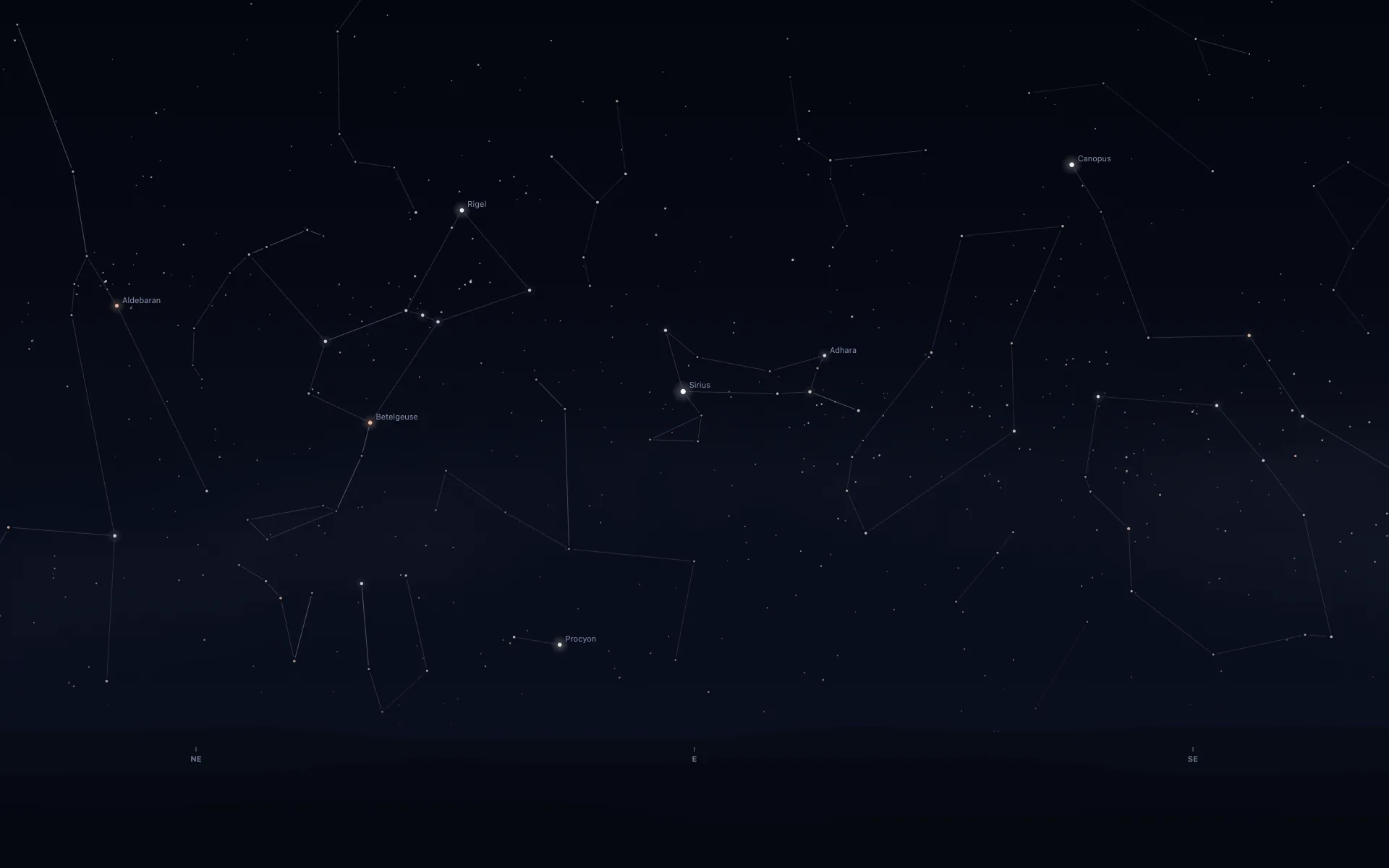
Orion on your Mac's desktop
Orbit, my Mac app, draws the real sky over one of 13 cities, or your own location, behind your desktop icons. Set Facing to East on a November evening and Orion comes up from behind the hills along the bottom of the screen (the same three hills for every city, not your skyline). With Labels on the Sky on, Betelgeuse, Rigel, Sirius and Aldebaran get their names.
It has limits. The belt stars are a touch too faint for a label, this version writes no constellation names on the sky, and it draws neither the nebula nor meteors, so its sword is a short line of faint dots. The constellation lines are hairlines that stop short of each star, because when I first built the sky they came out louder than the stars.
The sky turns about four pixels a minute on a 1080p screen, so you won't catch Orion climbing, but look up after an hour and he has.
Orbit is $6.99 once on the Mac App Store (₹699 in India), with no subscription, for macOS 15 or later on Apple silicon and Intel Macs, and you can see what it looks like on the Mac page.
Common questions
What are the names of the stars in Orion?
The two brightest are Betelgeuse, one of Orion's shoulders, and Rigel, one of his feet. Bellatrix is the other shoulder and Saiph the other foot. The three belt stars, from east to west, are Alnitak, Alnilam and Mintaka.
What is the brightest star in Orion?
Usually Rigel. In the star catalogue my app uses, Rigel is magnitude 0.18 and Betelgeuse 0.45, and smaller numbers mean brighter. Betelgeuse varies, though: it dimmed sharply from late 2019 and was back to its normal brightness by April 2020.
Can you see Orion from the southern hemisphere?
Yes. Its belt sits almost on the sky's equator, so the whole world gets to see it. From Australia he's on his head, with Rigel on top, and the belt and sword are known as the Saucepan. Sydney has him in the evening from mid-November to early June, crossing the northern sky 57 degrees up.
Can you see Orion from India?
Yes, and high. From Bengaluru the belt passes 76 degrees up, close to overhead, against 48 from New York and 37 from London. It's 10 degrees up in the east at 9:01 PM on 15 November and 7:03 PM on 15 December, and already 39 degrees up when the sky gets dark on 15 January.
How far away are the stars of Orion?
Each is at its own distance. NASA puts Betelgeuse at about 700 light-years, Rigel at about 860 and the Orion Nebula in the sword at about 1,500.
Where is Orion in the sky tonight?
In late October it rises around 10 to 11 PM and is high in the south-west before dawn (north-north-west from Sydney). From mid-November the belt is 10 degrees up in the east around 9 PM in most of the cities in the table, and two hours earlier each month after that. By March it's high in the south as soon as it's dark, or high in the north from Australia.
More guides
- How to find the North Star, and how high Polaris sits over your cityFind the North Star from the Big Dipper or Cassiopeia's W. It stands about as high as your latitude: 52° in London, 41° in New York, 13° in Bengaluru.
- Geminids 2026: the best night to watch, and when the Moon sets in 13 citiesThe Geminids peak on 14 December 2026 at 14:00 UT (7:30 PM in India) under a crescent Moon that sets early. The best night and moonset times for 13 cities.
- Supermoons in November and December 2026: the Beaver Moon and the Cold MoonTwo supermoons end 2026: the Beaver Moon on 24 November and the Cold Moon on 23 to 24 December, the year's closest full Moon. Moonrise times for 8 cities.
- Living with the real night sky as my Mac wallpaperMy Mac's wallpaper is the real night sky over the city I pick, redrawn every minute. What living with it is like, and why Bengaluru sees more sky than LA.
- A live sky wallpaper for Mac that follows your citySee Orbit's Mac sky wallpaper in action: choose a city, preview an ISS pass, open the menu bar briefing and understand what the desktop does between updates.
- A quick tour of Orbit on Android, and where to go after itWatch Orbit's real Android demo, then learn where to find the ISS, explore planets in 3D, move through time and check a rocket launch before heading outside.
- Does live wallpaper drain battery on a MacBook?A video wallpaper works on every frame it plays. Mine draws one picture of the sky a minute. Measured CPU and memory, and how to check any app yourself.
- Dynamic wallpaper not changing on your Mac? 8 things to check, in orderMac dynamic wallpaper not changing or moving? Set the menu to Dynamic, then check Location Services, your time zone and Appearance, on Tahoe and macOS 27.
- Earliest sunset of the year 2026, and why it comes before the shortest dayEarliest sunset of the year 2026: 4:28 PM on 7 December in New York, 3:51 PM on 12 December in London, and why it falls before the year's shortest day.
- Free night sky wallpapers for Mac: eight 5K skies, from Orion to a supermoonFree night sky wallpapers for Mac and MacBook in 5K, each a real sky on a real date: Orion over New York, a supermoon, the Southern Cross and the ISS.
- How do I know if I saw the ISS? Eight signs, and how to look up the passHow to know if you saw the ISS: a steady light, no blinking, a few minutes to cross. How to look up the pass, and rule out planes, Starlink and Tiangong.
- How my first Mac app got through App Review, Guideline 2.1 letter and allApple sent my first Mac app a Guideline 2.1 Information Needed letter. I answered the same day with a screen recording; it was approved five days later.
- How my Mac live wallpaper idles at 0.04% CPUMy live wallpaper idles at 0.04% CPU on a Mac. How it draws one picture of the sky a minute, stops when you can't see it, and what ate its memory instead.
- How to get a live wallpaper on a Mac: what moves, and what it costsHow to get a live wallpaper on a Mac, free or paid: Apple's aerials, video apps, Plash for GIFs and the real sky over your city, with what each one costs.
- How to get a live wallpaper on a MacBook Neo without eating its 8 GBYes, a MacBook Neo can run a live wallpaper. Which kinds go easy on its 8 GB, the free ones Apple ships, the 2408 by 1506 size, and what my app weighs.
- How to get ISS pass alerts on a Mac, now that NASA's space station emails are goneNASA stopped Spot the Station's email and text alerts on 12 June 2025. Here's how to get ISS pass alerts now, on your phone or right on your Mac's desktop.
- How to put the Moon phase in your Mac menu bar (or a widget)Six apps put the Moon phase in a Mac or MacBook menu bar, from free to $6.99. Also: how to add a Moon widget, what Weather shows, and 2026's full moons.
- How to see the ISS from India: when, which way to face and how high to lookThe ISS shows up over India in short runs at dawn and dusk. How to get the times for your city, which way to face, how high to look and why cities differ.
- Is the ISS coming down? Yes, on purpose, after it retires in 2030Yes, the ISS is coming down, on purpose: NASA plans to retire it in 2030 and sink it in the South Pacific. Why it can't stay up, and how to see it first.
- Leonid meteor shower 2026: the best night and hours to watch, city by cityThe Leonid meteor shower peaks on 17 to 18 November 2026. The half Moon sets near midnight, so the hours before dawn are dark. Best times for 10 cities.
- Mac apps without a subscription: 14 you can buy onceMac apps without a subscription: 14 you can buy once in 2026, from Magnet at $4.99 to BBEdit at $59.99, with update terms where the seller states them.
- Mars and Jupiter conjunction, November 2026: what time to look in your cityMars and Jupiter conjunction: 1.2 degrees apart before dawn, 15 and 16 November 2026. Times for New York, London, Bengaluru and Sydney, and which is which.
- Quadrantid meteor shower 2027: when to look in 16 cities, India includedThe Quadrantids peak on 4 January 2027 at 03:25 UT, for only a few hours, under a thin crescent Moon. When and where to look in 16 cities, India included.
- The best astronomy apps for Mac in 2026, and which ones are iPad appsThe best astronomy apps for Mac in October 2026: Stellarium, Night Sky, SkySafari, Starry Night 8 and more, with US prices and which ones are iPad apps.
- What is the bright star in the east before sunrise? Late 2026, date by dateThe bright star in the east before sunrise is Jupiter, then Venus from early November 2026. Where to look and how high, for New York, London and Bengaluru.
- Why the ISS is only visible at dawn and duskWe wrote the code that decides when the ISS is visible. The three tests it runs, the geometry of Earth's shadow, and 30 days of real passes over Bengaluru.