
Leonid meteor shower 2026: the best night and hours to watch, city by city
The Leonid meteor shower peaks on 17 to 18 November 2026. The half Moon sets near midnight, so the hours before dawn are dark. Best times for 10 cities.
The Leonids peak on the night of Tuesday 17 to Wednesday 18 November 2026, and the night before is nearly as good. The half Moon sets around midnight, while Leo, where the meteors seem to come from, is climbing out of the east. From a little before 1 AM in the US, Europe and Japan (between 1:30 and 2 AM in India) the Moon is gone and Leo is high enough for a fair rate. You then have until the sky starts to brighten, around 5 AM. It's a small shower this year, 10 an hour at a dark site if you're lucky and a few from a city, and nobody expects a storm.
The Leonids are bits of dust from Comet Tempel-Tuttle that burn up in our air when Earth passes through the comet's trail each November. A Leonid hits the air at 71 km a second (NASA), fast enough to cover the 845 km from Bengaluru to Mumbai, as the crow flies, in 12 seconds.
I worked out the moonset and dawn times below with Orbit, the Mac app I make, which, I should admit before you get excited, draws no meteors at all.
When do the Leonids peak in 2026?
The International Meteor Organization's 2026 calendar has the Leonids running from 6 to 30 November and peaking at 23:45 UT on 17 November, at about 15 meteors an hour in a perfect sky. A second forecast in the same calendar says 16:00 UT that day. The link is an archived copy, because on 20 October 2026 imo.net was offline after a cyberattack.
In local time the main peak is 5:15 AM on the 18th in India, 11:45 PM on the 17th in London and 6:45 PM in New York, where Leo hasn't risen yet. The second forecast is 1 AM on the 18th in Tokyo, with Leo already 24° up, so Japan gets the better seat for that one.
The American Meteor Society's calendar names the night of 16 to 17 November as peak night instead. I'd still pick 17 to 18, the night nearest the IMO's main time in every city in the table, though in the Americas the IMO's second time (11 AM Eastern on the 17th) does sit nearer the 16th. At 10 or so an hour, a clear sky matters more than the exact date, so check the weather from the 15th and go out on whichever night looks clearer.
Best time to see the Leonids in 2026, city by city
The table covers the night of 17 to 18 November in 10 cities, plus moonset on the night before. The best window opens once Leo's radiant, the point the meteors seem to fly out of, is 20° up. That's two fists held at arm's length, high enough for a fair rate, and by then the Moon has set in every city here.
| City (local time) | Moon sets, 16 to 17 Nov | Moon sets, 17 to 18 Nov | Best window, 18 Nov |
|---|---|---|---|
| New York (EST) | 10:52 PM | 11:56 PM | 12:50 to 5:10 AM |
| Chicago (CST) | 10:47 PM | 11:51 PM | 12:45 to 5:05 AM |
| Los Angeles (PST) | 11:08 PM | 12:07 AM | 12:55 to 5:00 AM |
| London (GMT) | 10:15 PM | 11:29 PM | 12:45 to 5:25 AM |
| Berlin (CET) | 10:15 PM | 11:30 PM | 12:50 to 5:30 AM |
| Bengaluru (IST) | 11:35 PM | 12:24 AM | 1:50 to 5:05 AM |
| Delhi (IST) | 11:14 PM | 12:10 AM | 1:30 to 5:20 AM |
| Mumbai (IST) | 11:47 PM | 12:37 AM | 2:00 to 5:30 AM |
| Tokyo (JST) | 10:11 PM | 11:11 PM | 12:45 to 4:50 AM |
| Sydney (AEDT) | 1:08 AM | 1:37 AM | 3:30 to 4:05 AM, Leo under 20° |
NASA JPL's Horizons agrees with every moonset I checked (New York, London, Bengaluru, Tokyo and Sydney) to within a minute. The Hong Kong Observatory publishes its own moonsets, and for the same two nights (11:21 PM and 12:14 AM) they match the engine to the minute. Your exact spot can shift these by a few minutes, and buildings or hills to the west will hide the Moon earlier than the table says.
Don't pack up early. Leo keeps climbing until dawn, when the radiant is 67° up in the south-east from New York, 58° in the south-south-east from London and Berlin, and 66° in the east-north-east from Bengaluru. The AMS says most showers are best between midnight and dawn, and with Leo that high, the last hour or two before the sky brightens should be the best part of the night.
From Sydney the radiant rises only at 2:20 AM and is 17° up at 4 AM, as the sky starts to brighten, so you might catch a few low in the north-east and not much more.
Will the Moon spoil the Leonids in 2026?
First quarter is at 11:48 UT on 17 November 2026, according to NASA's catalogue of Moon phases: 6:48 AM in New York, 5:18 PM in India. That evening the Moon is a little over half lit, and it sets between 11:10 PM and 12:40 AM in the northern cities in the table. On the 16th it's a bit under half lit and sets about an hour earlier.
Leo's radiant rises between 10:20 and 11:10 PM in the US and Europe, and the Moon sets an hour or so later. In Bengaluru the two nearly trade places: the radiant rises at 12:20 AM and the Moon sets at 12:24. Before midnight Leo is below the horizon or barely above it, and the IMO calendar expects no moonlight trouble near the maximum.
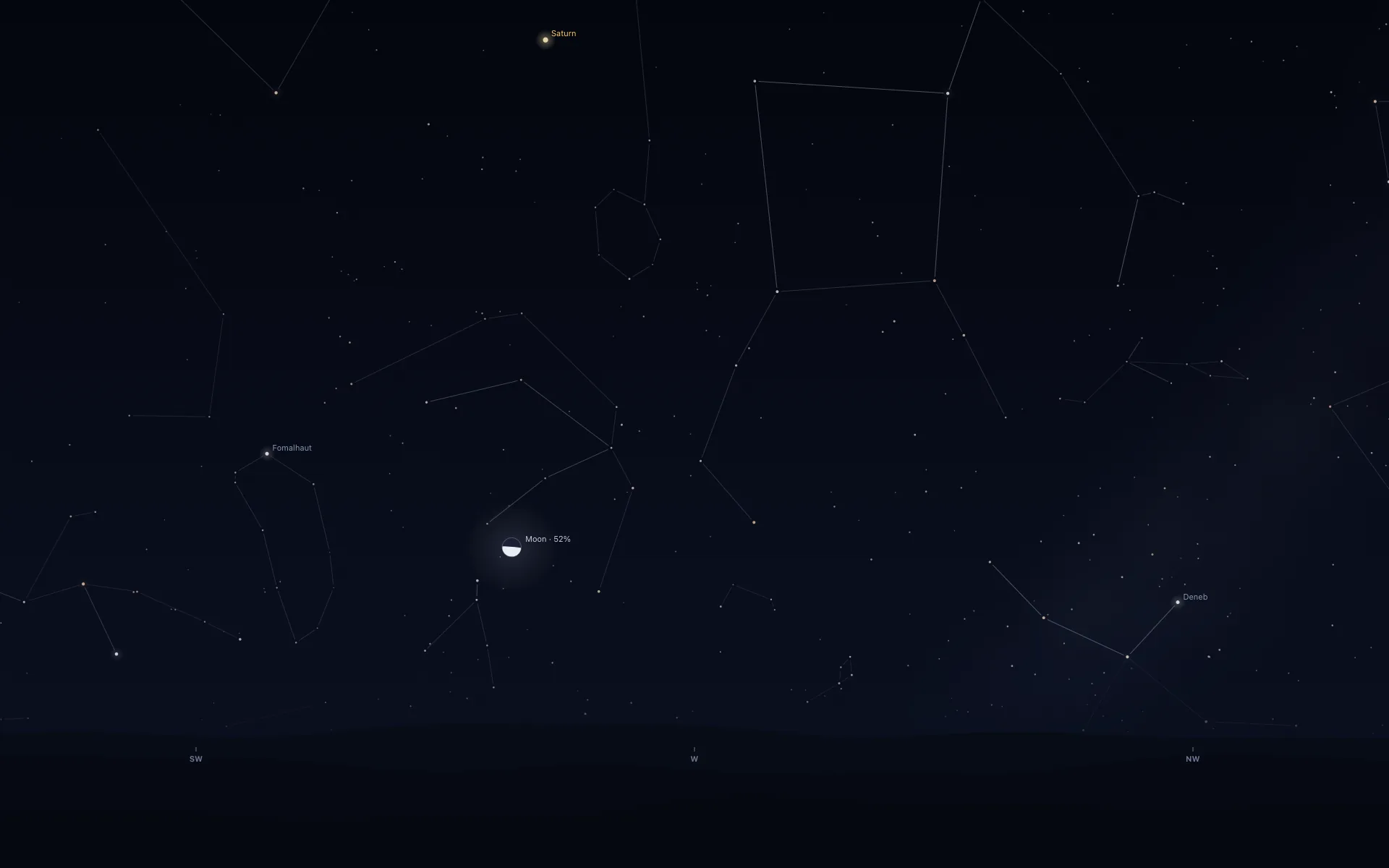
The Farmers' Almanac's Leonid page, one of the first results Google shows for "leonid meteor shower 2026", has a different Moon: a 6% waxing crescent that sets in the early evening. The same page gives the new Moon as 9 November, which is right, and eight or nine days after a new Moon the Moon is about half lit and sets around midnight. Their advice, to watch from after midnight until about 5:30 AM, still works.
What time to see the Leonids in India
Go out on the night of Tuesday 17 to Wednesday 18 November. Leo has climbed to 20° by 1:30 AM in Delhi, 1:50 in Bengaluru and 2:00 in Mumbai, and the sky starts to brighten between 5:05 and 5:30 AM.
The IMO's main peak lands at 5:15 AM IST on the 18th, ten minutes after Bengaluru's sky starts to get light. Rude of it, but Leo is 68° up by then, so the dark hour before it is worth setting an alarm for. The second forecast, 9:30 PM IST on the 17th, comes before Leo has risen here.
If the forecast for the 17th looks worse than the 16th, go out on the 16th instead. In Bengaluru the Moon sets at 11:35 PM that night and Leo reaches 20° at 1:51 AM.
Where to look for the Leonids in 2026
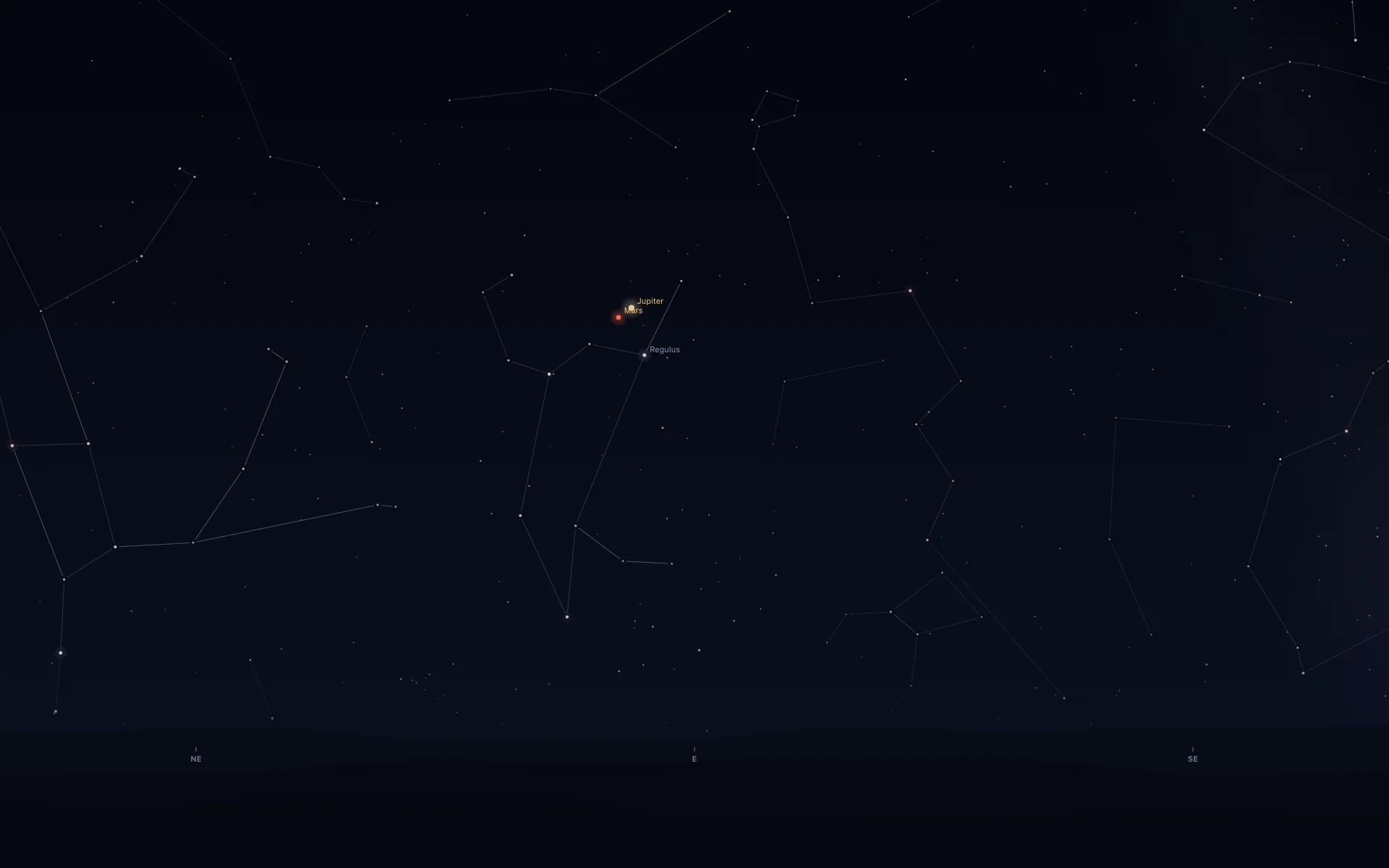
The radiant sits in Leo's head, a backwards question mark of stars, about a fist from Leo's brightest star, Regulus. Leo rises in the east late in the evening and by dawn is high in the south-east, or high in the east from India. Meteors can show up anywhere in the sky, and NASA's advice is not to stare at Leo, because they look longer away from the radiant. Trace a trail backwards and it points to Leo.
Mars and Jupiter are both inside Leo this year. On Leonid morning the two planets are 1.4° apart, 4° from Regulus and 8 to 9° from the radiant, a little under a fist (NASA JPL Horizons, 08:00 UT on 18 November). Jupiter, at magnitude minus 2.1 (smaller numbers are brighter), is the brightest thing in that part of the sky, and Mars outshines Regulus too, so Jupiter is the easiest place to start.
They're closest at 02:04 UT on 16 November (the evening of the 15th in the Americas), 1.19° apart. I've written up Mars and Jupiter in November 2026 separately.
How many Leonids will you see?
The IMO's 15 an hour is a ZHR, the astronomers' best case: what one person would count in an hour under a perfectly dark, clear sky with Leo straight overhead (AMS). Nobody gets that. With Leo high before dawn, a dark field might give you 10 an hour on a good night, and a city a few. NASA says Leonid rates are often as low as about three an hour.
From a city you'll see fewer still: streetlights hide the faint meteors along with the faint stars.
If you'd rather drive somewhere dark for one shower this year, make it the Geminids. The IMO has them peaking at 14:00 UT on 14 December, with a ZHR of 150 and only a waxing crescent Moon. The Geminid meteor shower 2026 guide has the best night and the moonsets city by city.
When was the last Leonid meteor storm?
No storm this year. Two dust-trail modellers quoted by the IMO find Earth brushing thin, old trails between 17 and 19 November. One says that's not enough for a significant outburst, and the other allows for a modest rise.
The last storm was in 2002, says NASA, which counts a storm as at least 1,000 meteors an hour. Watchers in 1966 saw thousands a minute for about 15 minutes. The AMS calendar lists Leonid storms in 1833, 1866, 1966, 1999, 2001 and 2002, and its history pages describe the storm of 13 November 1833 being seen across the eastern half of North America.
The dust comes from Comet 55P/Tempel-Tuttle, which takes 33 years to go round the Sun, and NASA says a storm can come roughly that often. The comet is next closest to the Sun on 20 May 2031. The AMS says that return may bring no storm at all, but possibly several good displays of more than 100 an hour.
How to watch the Leonids
- 17 to 18 November, or 16 to 17 if that night's forecast is clearer. Go out once Leo is 20° up (the table above) and stay until the sky starts to brighten.
- Away from streetlights, with as little of the horizon blocked as you can manage.
- That's the minimum the AMS suggests, away from bright lights and phone screens. A dim red light is fine.
- Your eyes alone take in far more sky.
- The AMS suggests a dark patch about halfway between the horizon and overhead, not Leo itself.
- Before dawn in November it's cold in most of the cities in the table, so bring layers and something to lie on.
- Orbit has no cloud forecast.
- If a dazzling light is low in the east-south-east near the end of your watch, that's Venus, the bright star in the east before sunrise. A steady light that glides across without a streak is a satellite, maybe the ISS, which shows up near dawn and dusk.
Tap a box as you go. Checks reset when you leave this page.
Where Orbit for Mac fits (and where it doesn't)
On Leonid night Orbit is a way to find Leo before you go out. It puts the real sky over your city on your Mac desktop, redrawn once a minute, and the Moon in the menu bar is drawn in tonight's phase. Set Facing to East and turn on Labels on the Sky, and after midnight that week Regulus and Jupiter are named as Leo climbs, with Mars's label squeezed in under Jupiter's. Leo's own figure is drawn in faint lines, but version 1.0 doesn't write constellation names on the sky.
The pictures above came from its renderer ahead of time. In the app itself the desktop shows the sky as it is now, and there's no way to pick a date.
Orbit: Live Sky Desktop is $6.99 once on the Mac App Store (₹699 in India), with no subscription or in-app purchases, and no account to make. It needs macOS 15 or later, runs on Apple silicon and Intel, and the download is about 1.4 MB. The Mac page has screenshots and the rest of the details.
Common questions
When do the Leonids peak in 2026?
The International Meteor Organization puts the maximum at 23:45 UT on 17 November 2026 (6:45 PM in New York, 11:45 PM in London, 5:15 AM on the 18th in India), with a second forecast at 16:00 UT that day. The best hours for most people are after midnight on the night of 17 to 18 November, and the night before is nearly as good. The theoretical best is about 15 an hour. A dark site might give you 10, a city a few, and nobody expects a storm.
Will the Moon spoil the Leonids in 2026?
No. First quarter is at 11:48 UT on 17 November (NASA), so the Moon is about half lit and sets between about 11:30 PM and 12:40 AM in the US, Europe and India. Leo, where the meteors seem to come from, is still low at that hour, so the useful hours after midnight have no Moon in them.
What time can I see the Leonids in India?
On the night of Tuesday 17 to Wednesday 18 November 2026: 1:50 to 5:05 AM in Bengaluru, 1:30 to 5:20 AM in Delhi and 2:00 to 5:30 AM in Mumbai. The Moon sets shortly after midnight, and Leo rises in the east and climbs high by dawn. These times are for the city centres and were computed on 20 October 2026.
Where should I look to see the Leonids?
Anywhere with a wide view of dark sky. The meteors can appear all over, but their trails point back to Leo, low in the east after midnight and high in the south-east by dawn (high in the east from India). This year Mars and Jupiter sit a few degrees from Leo's brightest star, Regulus, close to that spot.
How often is the Leonid meteor shower?
Every year, from 6 to 30 November. About every 33 years, when Comet Tempel-Tuttle comes back, the Leonids can turn into a storm of a thousand or more an hour. The last one was in 2002, according to NASA, and the comet is next closest to the Sun on 20 May 2031.
More guides
- Mars and Jupiter conjunction, November 2026: what time to look in your cityMars and Jupiter conjunction: 1.2 degrees apart before dawn, 15 and 16 November 2026. Times for New York, London, Bengaluru and Sydney, and which is which.
- Geminids 2026: the best night to watch, and when the Moon sets in 13 citiesThe Geminids peak on 14 December 2026 at 14:00 UT (7:30 PM in India) under a crescent Moon that sets early. The best night and moonset times for 13 cities.
- How to put the Moon phase in your Mac menu bar (or a widget)Six apps put the Moon phase in a Mac or MacBook menu bar, from free to $6.99. Also: how to add a Moon widget, what Weather shows, and 2026's full moons.
- A live sky wallpaper for Mac that follows your citySee Orbit's Mac sky wallpaper in action: choose a city, preview an ISS pass, open the menu bar briefing and understand what the desktop does between updates.
- A quick tour of Orbit on Android, and where to go after itWatch Orbit's real Android demo, then learn where to find the ISS, explore planets in 3D, move through time and check a rocket launch before heading outside.
- Does live wallpaper drain battery on a MacBook?A video wallpaper works on every frame it plays. Mine draws one picture of the sky a minute. Measured CPU and memory, and how to check any app yourself.
- Dynamic wallpaper not changing on your Mac? 8 things to check, in orderMac dynamic wallpaper not changing or moving? Set the menu to Dynamic, then check Location Services, your time zone and Appearance, on Tahoe and macOS 27.
- Earliest sunset of the year 2026, and why it comes before the shortest dayEarliest sunset of the year 2026: 4:28 PM on 7 December in New York, 3:51 PM on 12 December in London, and why it falls before the year's shortest day.
- Free night sky wallpapers for Mac: eight 5K skies, from Orion to a supermoonFree night sky wallpapers for Mac and MacBook in 5K, each a real sky on a real date: Orion over New York, a supermoon, the Southern Cross and the ISS.
- How do I know if I saw the ISS? Eight signs, and how to look up the passHow to know if you saw the ISS: a steady light, no blinking, a few minutes to cross. How to look up the pass, and rule out planes, Starlink and Tiangong.
- How my first Mac app got through App Review, Guideline 2.1 letter and allApple sent my first Mac app a Guideline 2.1 Information Needed letter. I answered the same day with a screen recording; it was approved five days later.
- How my Mac live wallpaper idles at 0.04% CPUMy live wallpaper idles at 0.04% CPU on a Mac. How it draws one picture of the sky a minute, stops when you can't see it, and what ate its memory instead.
- How to find Orion and its belt, with times for 13 citiesHow to find Orion: its belt is three stars in a short, straight row, low in the east on November evenings. Times for 13 cities, and why Australia flips it.
- How to find the North Star, and how high Polaris sits over your cityFind the North Star from the Big Dipper or Cassiopeia's W. It stands about as high as your latitude: 52° in London, 41° in New York, 13° in Bengaluru.
- How to get a live wallpaper on a Mac: what moves, and what it costsHow to get a live wallpaper on a Mac, free or paid: Apple's aerials, video apps, Plash for GIFs and the real sky over your city, with what each one costs.
- How to get a live wallpaper on a MacBook Neo without eating its 8 GBYes, a MacBook Neo can run a live wallpaper. Which kinds go easy on its 8 GB, the free ones Apple ships, the 2408 by 1506 size, and what my app weighs.
- How to get ISS pass alerts on a Mac, now that NASA's space station emails are goneNASA stopped Spot the Station's email and text alerts on 12 June 2025. Here's how to get ISS pass alerts now, on your phone or right on your Mac's desktop.
- How to see the ISS from India: when, which way to face and how high to lookThe ISS shows up over India in short runs at dawn and dusk. How to get the times for your city, which way to face, how high to look and why cities differ.
- Is the ISS coming down? Yes, on purpose, after it retires in 2030Yes, the ISS is coming down, on purpose: NASA plans to retire it in 2030 and sink it in the South Pacific. Why it can't stay up, and how to see it first.
- Living with the real night sky as my Mac wallpaperMy Mac's wallpaper is the real night sky over the city I pick, redrawn every minute. What living with it is like, and why Bengaluru sees more sky than LA.
- Mac apps without a subscription: 14 you can buy onceMac apps without a subscription: 14 you can buy once in 2026, from Magnet at $4.99 to BBEdit at $59.99, with update terms where the seller states them.
- Quadrantid meteor shower 2027: when to look in 16 cities, India includedThe Quadrantids peak on 4 January 2027 at 03:25 UT, for only a few hours, under a thin crescent Moon. When and where to look in 16 cities, India included.
- Supermoons in November and December 2026: the Beaver Moon and the Cold MoonTwo supermoons end 2026: the Beaver Moon on 24 November and the Cold Moon on 23 to 24 December, the year's closest full Moon. Moonrise times for 8 cities.
- The best astronomy apps for Mac in 2026, and which ones are iPad appsThe best astronomy apps for Mac in October 2026: Stellarium, Night Sky, SkySafari, Starry Night 8 and more, with US prices and which ones are iPad apps.
- What is the bright star in the east before sunrise? Late 2026, date by dateThe bright star in the east before sunrise is Jupiter, then Venus from early November 2026. Where to look and how high, for New York, London and Bengaluru.
- Why the ISS is only visible at dawn and duskWe wrote the code that decides when the ISS is visible. The three tests it runs, the geometry of Earth's shadow, and 30 days of real passes over Bengaluru.