
Is the ISS coming down? Yes, on purpose, after it retires in 2030
Yes, the ISS is coming down, on purpose: NASA plans to retire it in 2030 and sink it in the South Pacific. Why it can't stay up, and how to see it first.
Yes. NASA and its partners plan to keep the International Space Station flying through 2030 and then bring it down on purpose, steering it into an empty stretch of the South Pacific with a US Deorbit Vehicle built by SpaceX. By then its oldest modules will be past the life they were designed for, and NASA would rather rent space on commercial stations than keep running this one.
If the plan holds, you have about four years to see it with your own eyes, and on the right evenings or mornings that's easy. The station is also the only fast-moving thing in the sky my Mac app draws, so I have a selfish interest in when it goes.
Is the space station still in use?
Yes, and it's busy. Someone has lived aboard every day since 2 November 2000. NASA's update of 13 October 2026 counts seven people up there for Expedition 75 (three from Roscosmos, three from NASA and one from the Canadian Space Agency) and a new Dragon cargo ship on its way to them.
Orbit itself started with me wondering what view the people up there must have (the long version).
When is the ISS coming down, and what's the retirement date?
NASA's line, from the day it picked SpaceX to build the deorbit vehicle, is that the station comes down "after the end of its operational life in 2030". The US, Japan, Canada and ESA's participating countries have committed to running it that long. Russia had committed to at least 2028, and on 14 July 2026 the head of Roscosmos, Dmitry Bakanov, said the agencies had agreed to extend joint operations through 2030, TASS reported.
| Date | What |
|---|---|
| 26 Jun 2024 | NASA picks SpaceX to build the US Deorbit Vehicle |
| 1 Aug 2028 | The delivery date NASA's 2023 request for the vehicle asked for |
| 1 May 2029 | The latest delivery that request allowed |
| 30 Sep 2030 | The earliest end of operations Congress allows |
| Jan 2031 | The deorbit NASA's 2022 transition report assumed for its budget |
| After operations end | The final re-entry burn; NASA's 2024 documents give no date |
That January 2031 is where the "coming down in 2031" headlines come from. NASA's 2022 transition report budgeted for a deorbit then. Its newer deorbit white paper of June 2024, where most of the numbers in this post come from, gives an order of events instead of a date: drag lowers the station, the last crew comes home, and then operators "command a large re-entry burn". The two delivery dates are from a NASA procurement sheet.
All of this could still slide. If no commercial station is ready by 2030, the white paper says extending the ISS "is a possibility", and the deorbit vehicle can wait on the ground. The US Government Accountability Office wrote in June 2026 that NASA has to judge in 2027 whether one will be ready in time.
Why is the space station being decommissioned?
The frame is getting old, and NASA would rather be a customer than a landlord.
The first pieces, Zarya and Unity, went up in 1998. The modules and truss were designed for 30 years in orbit, and by 2030 those first two will have done 32. The station goes round Earth 16 times a day, in and out of Earth's shadow, and that heating and cooling, plus the shove of every docking and undocking, is what wears the structure. Solar arrays, radios, life support and science kit can be swapped in orbit. The crewed modules and the truss "cannot be repaired or replaced practically".
To be fair to the old thing, NASA's own analyses "show ample margin to fly through at least 2030", and the forces on it have been lower than first forecast.
NASA's transition plan says its goal is "to be one of many customers" on commercially owned stations. Nobody wants the old one, either. When NASA asked US industry, it got "no feasible proposals" to use the hardware after the station's life, because of its age, its complexity and the way ownership is split between companies and countries.
Why can't the ISS just stay up there?
The station flies about 420 kilometres (260 miles) up and weighs about 420 tonnes, and even there the thin air drags it down. Without a push it would fall in roughly one to two years, so visiting ships nudge it up from time to time. On 27 August 2026 a Cygnus XL cargo ship fired its thrusters for 20 minutes and 43 seconds and raised the station's lowest point by about 4 kilometres (that one mainly lined the station up for a Russian cargo launch).
My first question would have been why nobody pushes it much higher and keeps it. NASA looked at that, and at every other way out, and turned each one down. Even a slow electric tug to a 1,000-year orbit only hands the problem to whoever is around in the year 3000.
| Option | The problem |
|---|---|
| Boost it to about 800 km | Crew and cargo ships are built for about 415 km, the climb needs tankers that don't exist, and a hole-punching debris hit would come every 4 years or so instead of every 51 |
| Electric tug to a 1,000-year orbit | About 3 years of constant thrust and 15,000 kg of propellant, through radiation belts it wasn't built for, and it still falls one day, uncontrolled |
| Break it up in orbit | About 220 million pieces of debris over 1 mm, against about 100 million up there now |
| Take it apart and bring it home | Building it took 27 shuttle flights plus partner missions, 13 years and 161 spacewalks, and NASA says no spacecraft today could carry modules home the way the shuttle did |
| Let it fall on its own | Very large pieces scattered over a wide area, somewhere under its path |
How will the ISS be deorbited, and where will it land?
US rules say a spacecraft coming back must keep the chance of hurting anyone on the ground no higher than 1 in 10,000. The ISS is so big that an uncontrolled fall would scatter very large pieces over a wide area, so it needs a controlled re-entry, and Russia's Progress cargo ships don't have enough push to do that on their own.
That's the job of the US Deorbit Vehicle. SpaceX's contract is worth up to $843 million, and the vehicle is a Dragon with an upgraded trunk, the section behind the capsule. NASA will own and fly it, and said in 2024 that it would buy the launch separately. At the end it breaks up along with the station.
First, drag is left to pull the station down as far as is safe, so the final burn has less work to do. Once all the crew are home, operators line up its path over the ground and fire one large burn. The aim is to keep the falling debris in a strip no more than about 6,000 km long, in an uninhabited part of the South Pacific. The 2022 transition report places it around Point Nemo, the spot in the ocean farthest from land, so there's no beach nearby to watch from. What survives sinks, and toxic liquids are expected to burn up on the way down.
Mir went the same way on a smaller scale. Russia's station came down over the Pacific in a controlled deorbit on 23 March 2001 after 15 years up, its debris falling east of New Zealand.
What will replace the ISS?
Several private stations, with NASA as a paying customer. On 9 October 2026 NASA released its final request for proposals for commercial space stations. Proposals are due on 8 December, and contracts are expected in spring 2027. The GAO counts six US companies working with NASA and sees "several risks that could lead to a gap in human presence" in low Earth orbit.
The four names you'll see most, as last reported:
| Station | Who is building it | Status as reported | Source |
|---|---|---|---|
| Axiom Station | Axiom Space | First module to launch no earlier than 2028 and dock at the ISS; a second about a year later, for a four-person station before the ISS shuts down | Payload, 13 Feb 2026 |
| Haven-1 | Vast | In integration; Vast says it will be ready to launch in the first quarter of 2027, on a Falcon 9 | Vast, 20 Jan 2026 |
| Starlab | Starlab Space, with Voyager, Airbus, Mitsubishi and others | Finished its commercial critical design review and moved into fabrication; no launch year given | Starlab, 23 Feb 2026 |
| Orbital Reef | Blue Origin | Passed a human-in-the-loop test milestone with life-size mock-ups; no launch date published | NASA, 16 Apr 2025 |
Sources: Payload on Axiom, Vast, Starlab and NASA on Orbital Reef. As of 20 October 2026 none of them is in orbit, and the earliest launch any of them names is Haven-1's, early in 2027.
Closer to home for me, India plans its own five-module Bharatiya Antariksh Station, and the Cabinet has approved the first module, BAS-01, for launch by 2028, says the Department of Space.
How to see the ISS before it comes down
You don't need a telescope. Visible passes happen only in the hour or two after sunset or before sunrise, when you're in the dark and the station is still in sunlight (why it only shows up at dawn and dusk). How to know if you saw the ISS covers what it looks like, and there's a separate guide to seeing it from India.
Passes come in runs of a few days, and my own city gets none this week: Orbit's ISS tile for Bengaluru says "No pass", with "in the next four days" under it. Sydney does better:
| Day | Rises | Highest | Brightness (Heavens-Above) |
|---|---|---|---|
| Monday 26 October | 8:21 PM, southwest | 29° | Magnitude −2.5 |
| Wednesday 28 October | 8:23 PM, southwest | 81°, nearly overhead | Magnitude −3.8 |
Heavens-Above agrees on both peak heights, and either pass outshines every star. Orbit times a pass from horizon to horizon (11 minutes on Monday), but you only see the sunlit part: on Monday the station slides into Earth's shadow at about 8:27 PM, 22° up in the east-southeast, so you'd get about four minutes of it more than 10° up. Orbit's desktop fades it out at the shadow too. I computed these with Orbit's engine on 20 October 2026; the times shift as the orbit data is updated, so check on the day.
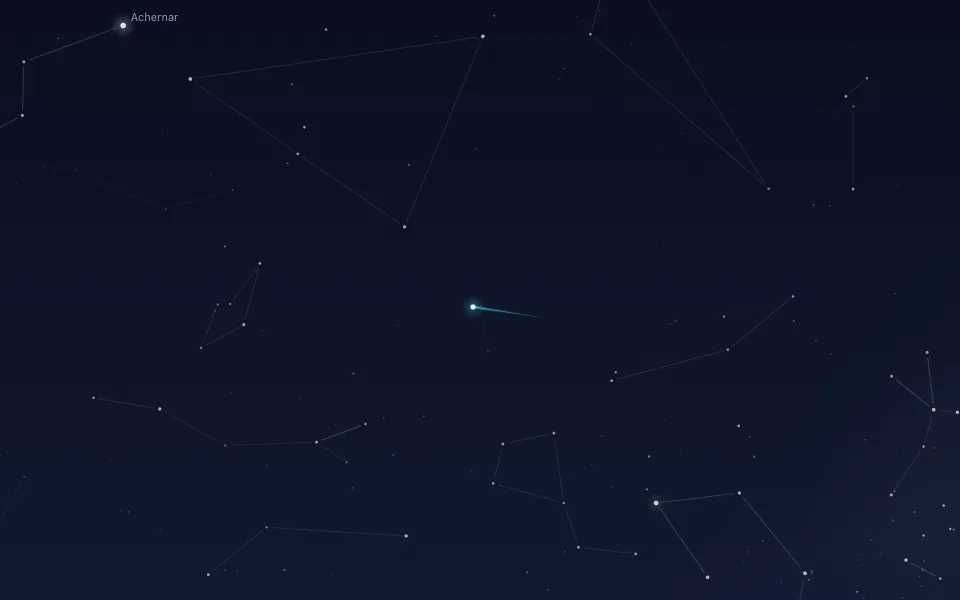
Keeping track of those runs is one of the jobs I built Orbit for Mac to do. Click the Moon in the menu bar and its card shows the time of the next visible pass over a little arc as high as it climbs, with a gold button that plays it across your desktop in twelve seconds. During the real pass, the station crosses the sky on your desktop as a white point with a cyan trail.
Switch on ISS Passes and a silent "ISS rises in 5 minutes" arrives before every visible pass. (Orbit plans those while its sky is showing, so a Mac stuck behind a full-screen app for days runs out of them.) It's $6.99 once on the Mac App Store, no subscription, for macOS 15 or later on Apple silicon and Intel. The Mac page has screenshots, and ISS pass alerts on a Mac walks through the setup.
If you'd rather have it on your phone, Orbit on Android is free on Google Play and alerts you 12 minutes before a visible pass.
Common questions
Is the ISS going to crash?
Not by accident. NASA plans a controlled re-entry after the station's operations end in 2030: a SpaceX-built US Deorbit Vehicle will push it down so that whatever survives falls in an uninhabited part of the South Pacific. An uncontrolled fall could drop large pieces anywhere under its path, which is why NASA ruled it out.
When will the ISS come down to Earth?
NASA and its partners plan to operate it through 2030, and Congress has told NASA to fly it to at least 30 September 2030. Drag is allowed to lower it, the last crew comes home, then a final re-entry burn sends it down. NASA's 2022 transition report budgeted for that in January 2031; its 2024 documents give no date. If no commercial station is ready, operations could be extended.
Why do some reports say the ISS comes down in 2031?
Because NASA's own 2022 transition report assumed a deorbit in January 2031 when it worked out the cost of flying the station through 2030, and news coverage took the date from there. NASA's newer documents, from 2024, give 2030 as the end of operations and no date for the final burn.
Is the ISS going to be replaced?
By commercial stations rather than one new government station. NASA asked companies for final proposals on 9 October 2026 and expects to award contracts in spring 2027. Axiom, Vast, Starlab Space and Blue Origin are all building stations, and as of 20 October 2026 none of them is in orbit.
Can you watch the ISS deorbit?
Almost certainly not. NASA's target is an uninhabited stretch of the South Pacific, chosen to be as far from people as possible. The time to see the station is now, during its ordinary passes in the hour or two after sunset or before sunrise.
More guides
- Why the ISS is only visible at dawn and duskWe wrote the code that decides when the ISS is visible. The three tests it runs, the geometry of Earth's shadow, and 30 days of real passes over Bengaluru.
- How to get ISS pass alerts on a Mac, now that NASA's space station emails are goneNASA stopped Spot the Station's email and text alerts on 12 June 2025. Here's how to get ISS pass alerts now, on your phone or right on your Mac's desktop.
- How do I know if I saw the ISS? Eight signs, and how to look up the passHow to know if you saw the ISS: a steady light, no blinking, a few minutes to cross. How to look up the pass, and rule out planes, Starlink and Tiangong.
- How to see the ISS from India: when, which way to face and how high to lookThe ISS shows up over India in short runs at dawn and dusk. How to get the times for your city, which way to face, how high to look and why cities differ.
- Living with the real night sky as my Mac wallpaperMy Mac's wallpaper is the real night sky over the city I pick, redrawn every minute. What living with it is like, and why Bengaluru sees more sky than LA.
- A live sky wallpaper for Mac that follows your citySee Orbit's Mac sky wallpaper in action: choose a city, preview an ISS pass, open the menu bar briefing and understand what the desktop does between updates.
- A quick tour of Orbit on Android, and where to go after itWatch Orbit's real Android demo, then learn where to find the ISS, explore planets in 3D, move through time and check a rocket launch before heading outside.
- Does live wallpaper drain battery on a MacBook?A video wallpaper works on every frame it plays. Mine draws one picture of the sky a minute. Measured CPU and memory, and how to check any app yourself.
- Dynamic wallpaper not changing on your Mac? 8 things to check, in orderMac dynamic wallpaper not changing or moving? Set the menu to Dynamic, then check Location Services, your time zone and Appearance, on Tahoe and macOS 27.
- Earliest sunset of the year 2026, and why it comes before the shortest dayEarliest sunset of the year 2026: 4:28 PM on 7 December in New York, 3:51 PM on 12 December in London, and why it falls before the year's shortest day.
- Free night sky wallpapers for Mac: eight 5K skies, from Orion to a supermoonFree night sky wallpapers for Mac and MacBook in 5K, each a real sky on a real date: Orion over New York, a supermoon, the Southern Cross and the ISS.
- Geminids 2026: the best night to watch, and when the Moon sets in 13 citiesThe Geminids peak on 14 December 2026 at 14:00 UT (7:30 PM in India) under a crescent Moon that sets early. The best night and moonset times for 13 cities.
- How my first Mac app got through App Review, Guideline 2.1 letter and allApple sent my first Mac app a Guideline 2.1 Information Needed letter. I answered the same day with a screen recording; it was approved five days later.
- How my Mac live wallpaper idles at 0.04% CPUMy live wallpaper idles at 0.04% CPU on a Mac. How it draws one picture of the sky a minute, stops when you can't see it, and what ate its memory instead.
- How to find Orion and its belt, with times for 13 citiesHow to find Orion: its belt is three stars in a short, straight row, low in the east on November evenings. Times for 13 cities, and why Australia flips it.
- How to find the North Star, and how high Polaris sits over your cityFind the North Star from the Big Dipper or Cassiopeia's W. It stands about as high as your latitude: 52° in London, 41° in New York, 13° in Bengaluru.
- How to get a live wallpaper on a Mac: what moves, and what it costsHow to get a live wallpaper on a Mac, free or paid: Apple's aerials, video apps, Plash for GIFs and the real sky over your city, with what each one costs.
- How to get a live wallpaper on a MacBook Neo without eating its 8 GBYes, a MacBook Neo can run a live wallpaper. Which kinds go easy on its 8 GB, the free ones Apple ships, the 2408 by 1506 size, and what my app weighs.
- How to put the Moon phase in your Mac menu bar (or a widget)Six apps put the Moon phase in a Mac or MacBook menu bar, from free to $6.99. Also: how to add a Moon widget, what Weather shows, and 2026's full moons.
- Leonid meteor shower 2026: the best night and hours to watch, city by cityThe Leonid meteor shower peaks on 17 to 18 November 2026. The half Moon sets near midnight, so the hours before dawn are dark. Best times for 10 cities.
- Mac apps without a subscription: 14 you can buy onceMac apps without a subscription: 14 you can buy once in 2026, from Magnet at $4.99 to BBEdit at $59.99, with update terms where the seller states them.
- Mars and Jupiter conjunction, November 2026: what time to look in your cityMars and Jupiter conjunction: 1.2 degrees apart before dawn, 15 and 16 November 2026. Times for New York, London, Bengaluru and Sydney, and which is which.
- Quadrantid meteor shower 2027: when to look in 16 cities, India includedThe Quadrantids peak on 4 January 2027 at 03:25 UT, for only a few hours, under a thin crescent Moon. When and where to look in 16 cities, India included.
- Supermoons in November and December 2026: the Beaver Moon and the Cold MoonTwo supermoons end 2026: the Beaver Moon on 24 November and the Cold Moon on 23 to 24 December, the year's closest full Moon. Moonrise times for 8 cities.
- The best astronomy apps for Mac in 2026, and which ones are iPad appsThe best astronomy apps for Mac in October 2026: Stellarium, Night Sky, SkySafari, Starry Night 8 and more, with US prices and which ones are iPad apps.
- What is the bright star in the east before sunrise? Late 2026, date by dateThe bright star in the east before sunrise is Jupiter, then Venus from early November 2026. Where to look and how high, for New York, London and Bengaluru.