
Quadrantid meteor shower 2027: when to look in 16 cities, India included
The Quadrantids peak on 4 January 2027 at 03:25 UT, for only a few hours, under a thin crescent Moon. When and where to look in 16 cities, India included.
The Quadrantids, the first big meteor shower of 2027, peak on Monday 4 January at about 03:25 UT (Universal Time, the same as GMT). That's 3:25 AM in London, 10:25 PM on Sunday 3 January in New York and 8:55 AM in India. The peak lasts only a few hours and the Moon is a thin crescent that comes up late, so watch on the night of Sunday 3 to Monday 4 January, after midnight and before the sky starts to brighten.
I worked out every local time on this page on 20 October 2026 with the astronomy code inside Orbit, the Mac app I make. As a check, timeanddate puts New York's moonrise that morning at 4:57 AM and my sums put it at 4:58, which is about the size of error to expect.
When is the Quadrantid peak in 2027, and how long does it last?
The International Meteor Organization's 2027 calendar puts the maximum at 03:25 UT on 4 January, give or take about two and a half hours, and lists the Quadrantids as the first of the year's large annual showers. They're active from 28 December to 12 January, with a zenithal hourly rate (ZHR) of 80 that can vary from about 60 to 200.
The peak is short, a few hours (the American Meteor Society says about six), because Earth cuts across this stream of grit at a right angle instead of running along it (NASA). Geminid peaks stay strong for 10 to 12 hours in a typical year, by the IMO's count. The Quadrantids are over in a few.
London gets the peak at 3:25 AM on Monday with the radiant, the spot the meteors seem to fly out of, 44 degrees up. Berlin gets it at 4:25 AM with the radiant at 52. New York gets it at 10:25 PM on Sunday with the radiant 4 degrees up in the north-north-east, which in most of the city means behind a building. In Denver and Los Angeles it hasn't risen yet, and in India it's broad daylight. So this year Europe watches the peak itself (the AMS says the timing favours Europe and western Asia), the US 3 to 10 hours after it, India 3 to 6 and a half hours before, and Seoul and Tokyo 6 to 11 hours before.
Quadrantids 2027 and the Moon
At the peak the Moon is a waning crescent, 12% lit, and New Moon follows on 7 January (timeanddate; that's the UT date, and the early hours of the 8th in India and East Asia). It rises between about 3:20 and 6 AM in the northern cities on this page, low in the east-south-east to south-east, nowhere near the radiant. In Reykjavík it doesn't rise at all that day. The IMO calls the moonlight conditions "perfect".
You'll see 18% on the AMS calendar and anything from 9 to 16% on timeanddate, because a crescent this thin loses about 6 points of light a day and each site measures at a different hour. In 2027 the other two big showers aren't so lucky: the Perseids get a waxing Moon and the Geminids a full one.
What time to watch the Quadrantids in your city
The radiant is in the northern part of the constellation Boötes. While it's below about 20 degrees (two fists at arm's length), most of the shower is lost under the horizon, so each window below starts when the radiant clears 20 degrees and ends when dawn begins to lighten the sky (the Sun 18 degrees down).
| City | Peak (local) | Radiant 20° up | Dawn starts | Window I'd pick |
|---|---|---|---|---|
| New York | 10:25 PM Sun | 1:14 AM | 5:43 AM | 1:15 to 5:40 AM Mon |
| Chicago | 9:25 PM Sun | 1:02 AM | 5:39 AM | 1:05 to 5:35 AM Mon |
| Denver | 8:25 PM Sun | 1:24 AM | 5:45 AM | 1:25 to 5:40 AM Mon |
| Los Angeles | 7:25 PM Sun | 1:48 AM | 5:30 AM | 1:50 to 5:25 AM Mon |
| London | 3:25 AM Mon | 11:59 PM Sun | 6:03 AM | Midnight to 6:00 AM, peak at 3:25 |
| Berlin | 4:25 AM Mon | 11:54 PM Sun | 6:11 AM | 11:55 PM to 6:10 AM, peak at 4:25 |
| Reykjavík | 3:25 AM Mon | Above 20° all night | 7:55 AM | 7:10 PM Sun (full dark) to 7:50 AM Mon |
| Bengaluru | 8:55 AM Mon | 3:52 AM | 5:27 AM | 3:55 to 5:25 AM Mon |
| Seoul | 12:25 PM Mon | 2:09 AM | 6:14 AM | 2:10 to 6:10 AM Mon |
| Tokyo | 12:25 PM Mon | 1:28 AM | 5:21 AM | 1:30 to 5:20 AM Mon |
| Sydney | 2:25 PM Mon | Never (7° at most, in daylight) | 4:07 AM | No useful window |
The radiant climbs all night, so in every northern city the last dark hour is the best one. In New York it's 12 degrees up at midnight, 44 at 4 AM and about 60 when dawn starts. In London it ends up almost overhead at about 8:30 AM, which would be lovely if the Sun weren't up by then. In Reykjavík it never drops below 23 degrees, so the whole dark night counts, peak included.
Sydney is out of luck. The radiant gets 7 degrees up at most, at 9:24 AM in broad daylight, and stays below the horizon through every dark hour.
If Sunday is cloudy, try Monday night, but expect far fewer: the peak is only hours wide. The IMO does note that bright fireballs have been seen even a few days after the peak, so a clear Monday is still worth a look.
Which way to look: north-east, near the Big Dipper's handle
Find the Big Dipper, then follow the curve of its handle away from the bowl until you reach Arcturus, the bright orange star. Boötes is the long kite with Arcturus at its point. The radiant makes a triangle with Alkaid, the star at the tip of the handle, and the far end of the kite: about a fist and a half from Alkaid and about one fist from the end of the kite, on the side towards Polaris. There are no bright stars in that patch, which makes it easy to look straight past. If the Big Dipper is new to you, how to find the North Star starts with it.
You don't have to stare at the radiant. Meteors turn up all over the sky, and if you trace one backwards it points to that patch.
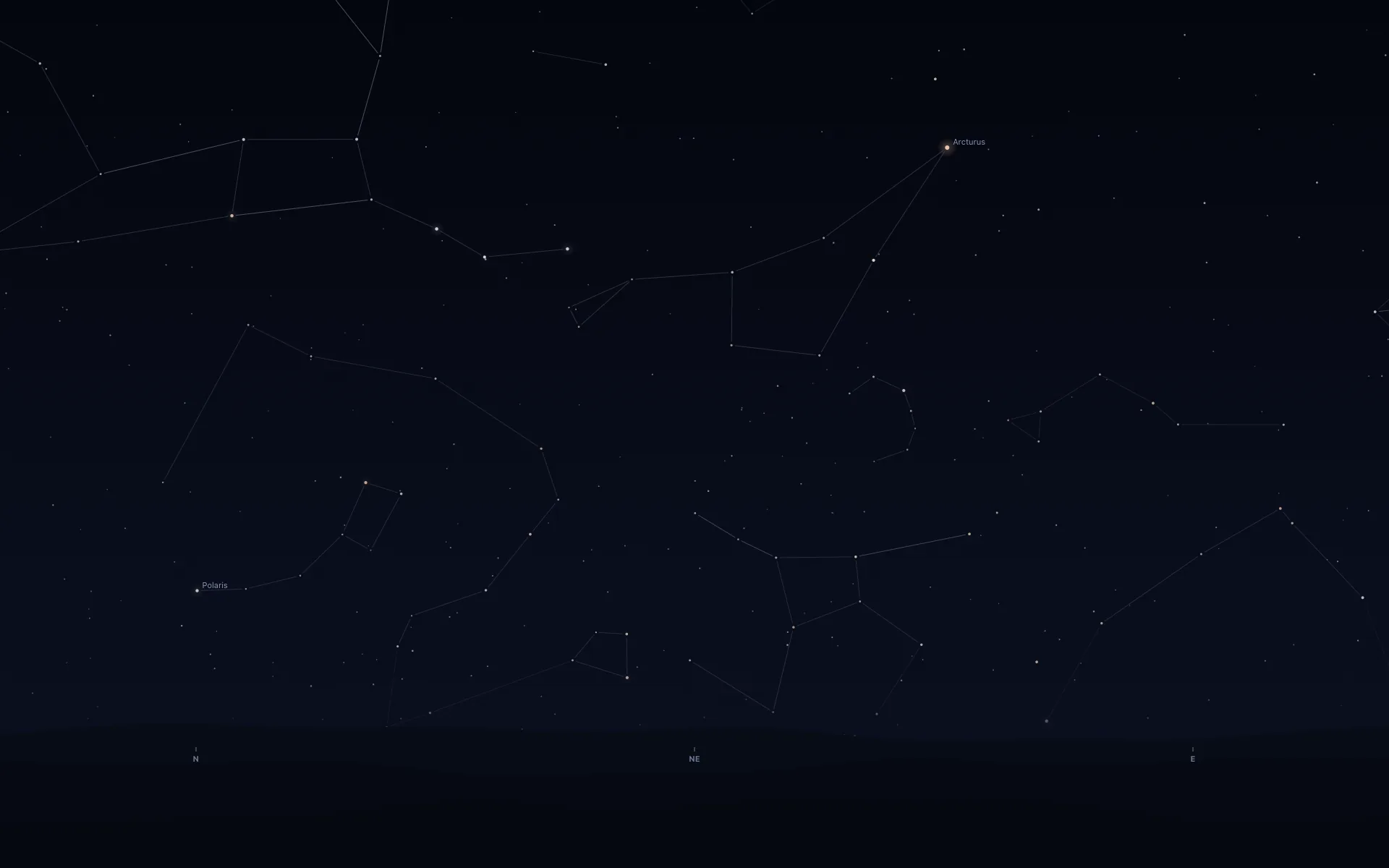
Quadrantid meteor shower 2027 in India: time and direction
You can see them from India if you don't mind an alarm on a Monday. From Bengaluru the radiant clears 20 degrees at 3:52 AM and is 35 degrees up when dawn starts at 5:27 AM, all in the north-east, three and a half to five hours before the 8:55 AM peak. Delhi gets the longest stretch, about three hours.
| City | Radiant 20° up | Dawn starts | Window | Radiant at dawn | Moonrise |
|---|---|---|---|---|---|
| Bengaluru | 3:52 AM | 5:27 AM | 3:55 to 5:25 AM | 35° | 3:41 AM |
| Mumbai | 3:43 AM | 5:55 AM | 3:45 to 5:50 AM | 41° | 4:14 AM |
| Delhi | 2:43 AM | 5:51 AM | 2:45 to 5:50 AM | 50° | 4:19 AM |
| Kolkata | 2:26 AM | 4:58 AM | 2:30 to 4:55 AM | 45° | 3:18 AM |
| Chennai | 3:41 AM | 5:17 AM | 3:45 to 5:15 AM | 35° | 3:31 AM |
| Hyderabad | 3:28 AM | 5:30 AM | 3:30 to 5:25 AM | 39° | 3:47 AM |
Bengaluru is my city, and its lights wash out most of the stars and the fainter meteors with them, so if you can get out of town, go.
How many Quadrantids an hour can you see?
Fewer than the ZHR suggests. That number assumes a perfect observer under a perfectly dark sky with the radiant straight overhead, which I explain in the Geminid guide. The AMS, more down to earth, expects about 25 an hour under dark skies.
By my arithmetic, correcting the ZHR for the radiant's height, the peak in London gives about 55 an hour under a properly dark sky far from any town, about 18 from a suburb and about 9 from a city. For New York, Bengaluru and the rest, watching hours away from the peak, expect fewer again. I haven't tried to put a number on that.
Recent years have mostly come in at the low end: the 2022, 2023 and 2025 peaks were in the lower part of that 60 to 200 range, the IMO says. The meteor modeller Jérémie Vaubaillon notes that the stream is slightly shifted this year, which might give a boost. I'd plan for the low end.
What is the Quadrantid meteor shower?
It's grit shed by the asteroid 2003 EH1, a rock about 3 km across. The Lowell Observatory's LONEOS survey found it on 6 March 2003, and the astronomer Peter Jenniskens worked out that it feeds the shower (NASA). It goes round the Sun every 5.5 years and swings out nearly as far as Jupiter's orbit (JPL). It has a catalogue number, 196256, but still no name.
The shower's name comes from Quadrans Muralis, a constellation the French astronomer Jérôme Lalande drew up in 1795 and the International Astronomical Union left off its official list in 1922. The radiant now sits in Boötes.
How to watch the Quadrantids
- The night of Sunday 3 to Monday 4 January. Go out at your city's time in the tables and stay until dawn if you can; the last dark hour is the best.
- Somewhere dark, with as much open sky as you can get. No telescope or binoculars; NASA suggests lying flat with your feet towards the north-east.
- NASA says eyes adapt to the dark in less than 30 minutes. Keep your phone in your pocket.
- Meteors arrive at random, with long lulls between them. Dress for a January night spent lying still.
Tap a box as you go. Checks reset when you leave this page.
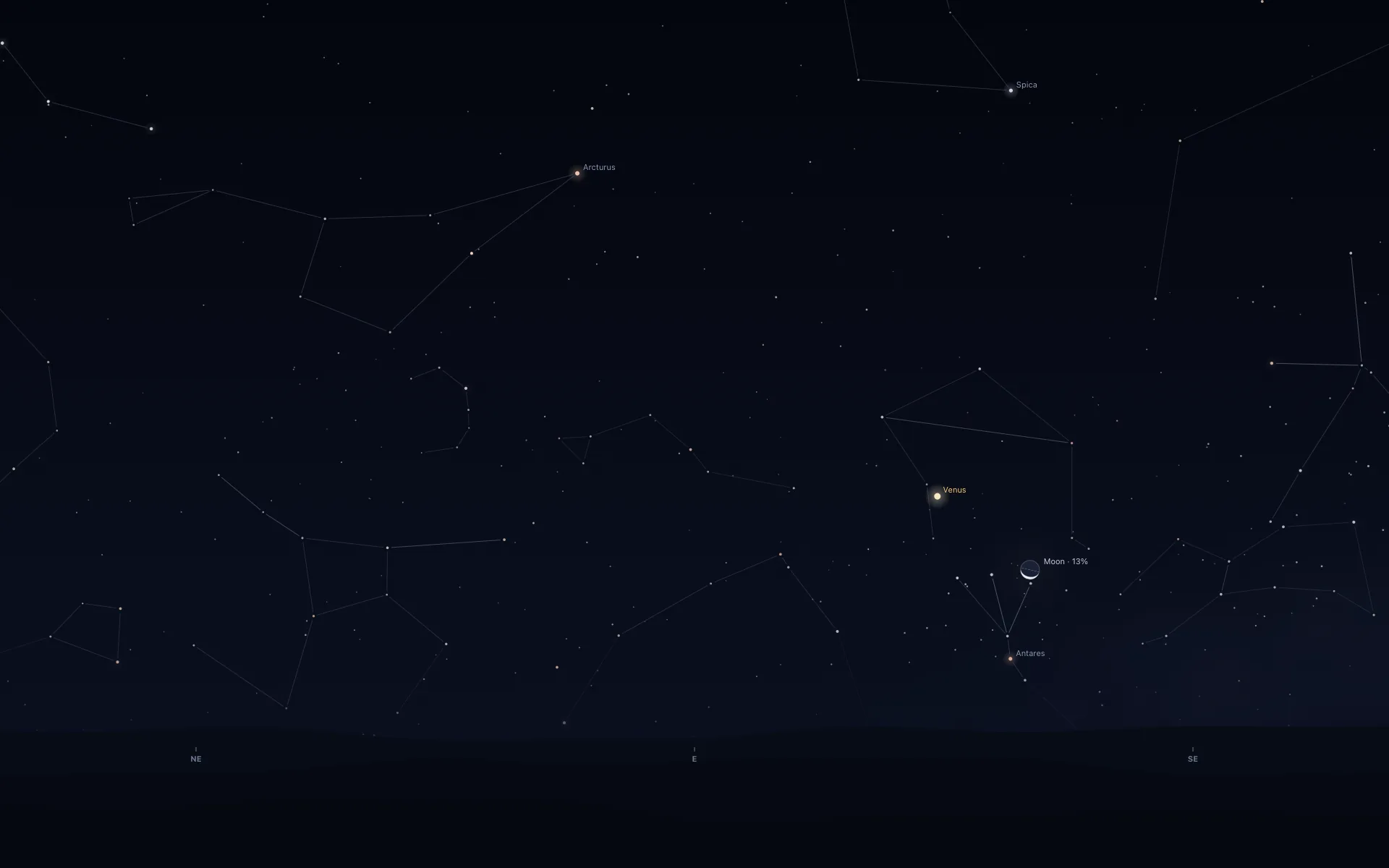
Before you head in, look low in the south-east (east-south-east from India). The brilliant point there is Venus, with the crescent Moon near it. The Leonids in November and the Geminids in December come first, if you'd like a practice run.
What Orbit for Mac shows on Quadrantid night
Orbit for Mac draws the real sky over your city behind your desktop icons: the Big Dipper and Boötes as thin constellation lines, Arcturus and Polaris named when Labels on the Sky is on, and the Moon in its true phase. If you check your Mac before heading out, set Facing to East. On a January morning that shows Arcturus and Boötes over your own city, and the crescent and Venus once they're up, like the Bengaluru picture above. It doesn't draw meteors or send meteor alerts. The small Moon in the menu bar shows tonight's phase too.
Orbit is $6.99 once (₹699 in India), no subscription, for macOS 15 or later on Apple silicon and Intel, on the Mac App Store.
Common questions
When do the Quadrantids peak in 2027?
The International Meteor Organization predicts the peak at 03:25 UT on Monday 4 January 2027, give or take about two and a half hours. That is 3:25 AM in London, 10:25 PM on Sunday 3 January in New York, 7:25 PM in Los Angeles and 8:55 AM in India. The peak lasts only a few hours, so the night of 3 to 4 January is the one to watch.
What is the Quadrantid meteor shower?
It's the first big meteor shower of the year, active from 28 December to 12 January, made of grit from the asteroid 2003 EH1. The meteors seem to fly out of northern Boötes, near the end of the Big Dipper's handle. It's named after Quadrans Muralis, a constellation drawn in 1795 that astronomers no longer use.
Which direction should I look for the Quadrantids?
North-east, and up. From the US and Europe the radiant sits low in the north in the evening; everywhere north of the equator it climbs the north-eastern sky after midnight, so NASA suggests lying back with your feet towards the north-east. Meteors can appear anywhere; trace one backwards and it points to a spot about 15 degrees from the end of the Big Dipper's handle.
How long does the Quadrantid meteor shower last?
The shower runs from 28 December to 12 January, but the peak is short: NASA says a few hours, and the American Meteor Society puts maximum activity at about six. So the hour you watch matters more than it does for most showers.
How many Quadrantids per hour can you see?
The IMO's zenithal hourly rate is 80, and it can vary from about 60 to 200; that figure assumes a perfectly dark sky with the radiant overhead. The American Meteor Society says to expect about 25 an hour under dark skies. By my arithmetic, at the peak in London a suburban sky gives about 18 an hour and a city sky about 9.
Can I see the Quadrantids from India?
Yes, low in the north-east before dawn on Monday 4 January, a few hours before the 8:55 AM IST peak. In Bengaluru the radiant clears 20 degrees at 3:52 AM and dawn begins at 5:27 AM; in Delhi the window opens earlier, at 2:45 AM. The thin crescent Moon, rising between about 3:20 and 4:20 AM, won't get in the way.
Can you see the Quadrantids from Australia?
Hardly. From Sydney the radiant climbs no higher than 7 degrees above the northern horizon, and only after sunrise; through the dark hours it stays below the horizon. NASA says the shower is best seen from the northern hemisphere.
More guides
- Geminids 2026: the best night to watch, and when the Moon sets in 13 citiesThe Geminids peak on 14 December 2026 at 14:00 UT (7:30 PM in India) under a crescent Moon that sets early. The best night and moonset times for 13 cities.
- Leonid meteor shower 2026: the best night and hours to watch, city by cityThe Leonid meteor shower peaks on 17 to 18 November 2026. The half Moon sets near midnight, so the hours before dawn are dark. Best times for 10 cities.
- How to find the North Star, and how high Polaris sits over your cityFind the North Star from the Big Dipper or Cassiopeia's W. It stands about as high as your latitude: 52° in London, 41° in New York, 13° in Bengaluru.
- What is the bright star in the east before sunrise? Late 2026, date by dateThe bright star in the east before sunrise is Jupiter, then Venus from early November 2026. Where to look and how high, for New York, London and Bengaluru.
- A live sky wallpaper for Mac that follows your citySee Orbit's Mac sky wallpaper in action: choose a city, preview an ISS pass, open the menu bar briefing and understand what the desktop does between updates.
- A quick tour of Orbit on Android, and where to go after itWatch Orbit's real Android demo, then learn where to find the ISS, explore planets in 3D, move through time and check a rocket launch before heading outside.
- Does live wallpaper drain battery on a MacBook?A video wallpaper works on every frame it plays. Mine draws one picture of the sky a minute. Measured CPU and memory, and how to check any app yourself.
- Dynamic wallpaper not changing on your Mac? 8 things to check, in orderMac dynamic wallpaper not changing or moving? Set the menu to Dynamic, then check Location Services, your time zone and Appearance, on Tahoe and macOS 27.
- Earliest sunset of the year 2026, and why it comes before the shortest dayEarliest sunset of the year 2026: 4:28 PM on 7 December in New York, 3:51 PM on 12 December in London, and why it falls before the year's shortest day.
- Free night sky wallpapers for Mac: eight 5K skies, from Orion to a supermoonFree night sky wallpapers for Mac and MacBook in 5K, each a real sky on a real date: Orion over New York, a supermoon, the Southern Cross and the ISS.
- How do I know if I saw the ISS? Eight signs, and how to look up the passHow to know if you saw the ISS: a steady light, no blinking, a few minutes to cross. How to look up the pass, and rule out planes, Starlink and Tiangong.
- How my first Mac app got through App Review, Guideline 2.1 letter and allApple sent my first Mac app a Guideline 2.1 Information Needed letter. I answered the same day with a screen recording; it was approved five days later.
- How my Mac live wallpaper idles at 0.04% CPUMy live wallpaper idles at 0.04% CPU on a Mac. How it draws one picture of the sky a minute, stops when you can't see it, and what ate its memory instead.
- How to find Orion and its belt, with times for 13 citiesHow to find Orion: its belt is three stars in a short, straight row, low in the east on November evenings. Times for 13 cities, and why Australia flips it.
- How to get a live wallpaper on a Mac: what moves, and what it costsHow to get a live wallpaper on a Mac, free or paid: Apple's aerials, video apps, Plash for GIFs and the real sky over your city, with what each one costs.
- How to get a live wallpaper on a MacBook Neo without eating its 8 GBYes, a MacBook Neo can run a live wallpaper. Which kinds go easy on its 8 GB, the free ones Apple ships, the 2408 by 1506 size, and what my app weighs.
- How to get ISS pass alerts on a Mac, now that NASA's space station emails are goneNASA stopped Spot the Station's email and text alerts on 12 June 2025. Here's how to get ISS pass alerts now, on your phone or right on your Mac's desktop.
- How to put the Moon phase in your Mac menu bar (or a widget)Six apps put the Moon phase in a Mac or MacBook menu bar, from free to $6.99. Also: how to add a Moon widget, what Weather shows, and 2026's full moons.
- How to see the ISS from India: when, which way to face and how high to lookThe ISS shows up over India in short runs at dawn and dusk. How to get the times for your city, which way to face, how high to look and why cities differ.
- Is the ISS coming down? Yes, on purpose, after it retires in 2030Yes, the ISS is coming down, on purpose: NASA plans to retire it in 2030 and sink it in the South Pacific. Why it can't stay up, and how to see it first.
- Living with the real night sky as my Mac wallpaperMy Mac's wallpaper is the real night sky over the city I pick, redrawn every minute. What living with it is like, and why Bengaluru sees more sky than LA.
- Mac apps without a subscription: 14 you can buy onceMac apps without a subscription: 14 you can buy once in 2026, from Magnet at $4.99 to BBEdit at $59.99, with update terms where the seller states them.
- Mars and Jupiter conjunction, November 2026: what time to look in your cityMars and Jupiter conjunction: 1.2 degrees apart before dawn, 15 and 16 November 2026. Times for New York, London, Bengaluru and Sydney, and which is which.
- Supermoons in November and December 2026: the Beaver Moon and the Cold MoonTwo supermoons end 2026: the Beaver Moon on 24 November and the Cold Moon on 23 to 24 December, the year's closest full Moon. Moonrise times for 8 cities.
- The best astronomy apps for Mac in 2026, and which ones are iPad appsThe best astronomy apps for Mac in October 2026: Stellarium, Night Sky, SkySafari, Starry Night 8 and more, with US prices and which ones are iPad apps.
- Why the ISS is only visible at dawn and duskWe wrote the code that decides when the ISS is visible. The three tests it runs, the geometry of Earth's shadow, and 30 days of real passes over Bengaluru.